

What the upcoming greenwashing directive means for your brand
Everything you need to know about the EmpCo Directive of September 2026.

From September 2026, brands will need to comply with the EmpCo Directive. EmpCo stands for Empowering Consumers for the Green Transition.
The EU introduced this directive to protect consumers against misleading sustainability claims, commonly referred to as greenwashing.
The directive requires sustainability claims to be clear, specific and supported by evidence.
And it is not only about words: even visual elements such as green colours, leaf emojis or images of nature may, in context, be considered a sustainability claim.
- [01]
All sustainability claims should be clear, specific and verifiable.
- [02]
Vague claims, such as “eco-friendly”, “sustainable”, “conscious” and “responsible”, should be accompanied by a clear explanation on the same medium.
- [03]
Sustainability labels must be EU approved or independently verified.
- [04]
Ensure the evidence for your claims is well-documented.
- [05]
Avoid making a claim about the sustainable performance of an entire product, when just a component is sustainable.
- [06]
Make future sustainability ambitions specific and supported by a credible plan.
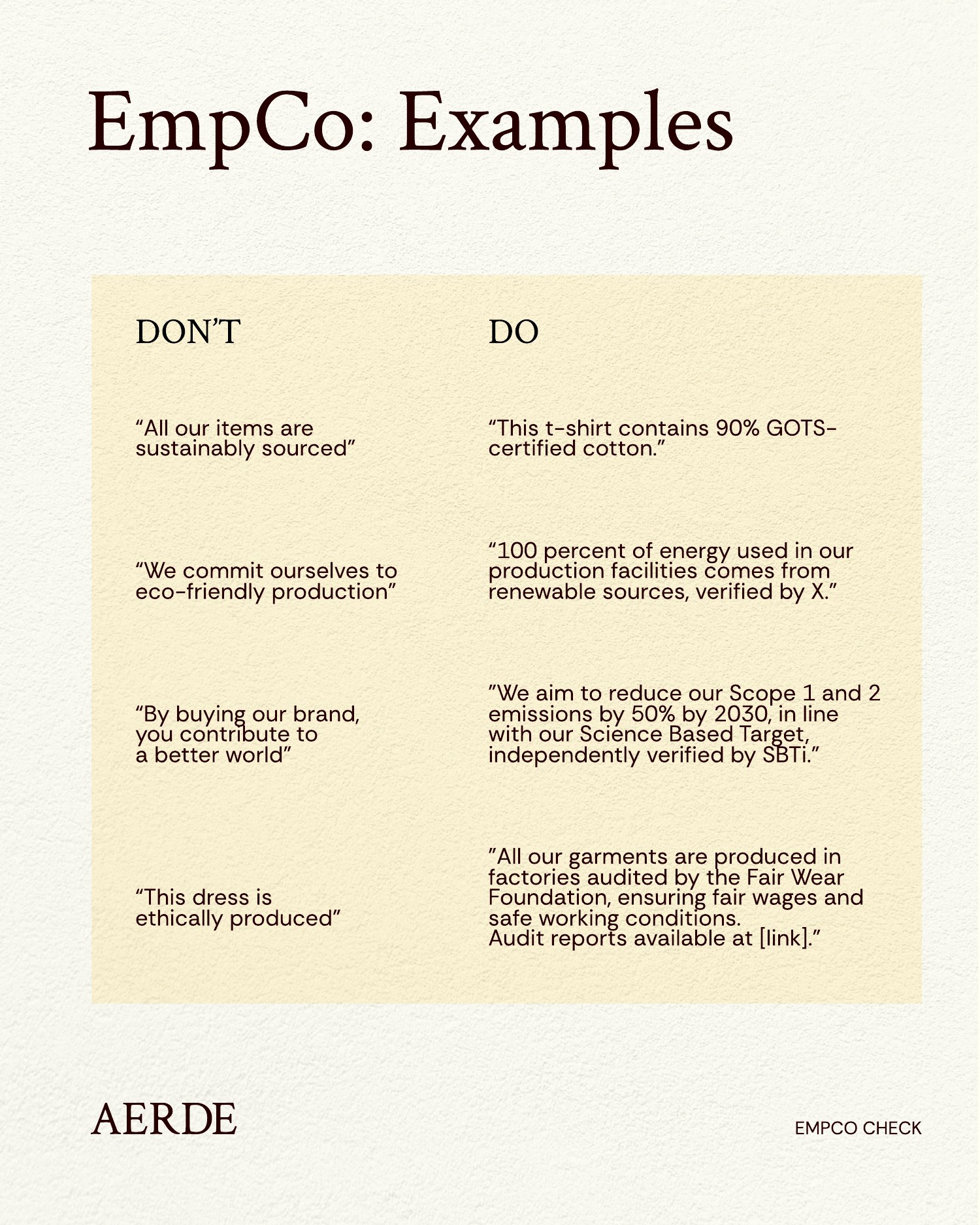
Don’t
- “All our items are sustainably sourced”
- “We commit ourselves to eco-friendly production”
- “By buying our brand, you contribute to a better world”
- “This dress is ethically produced”
Do
- “This t-shirt contains 90% GOTS-certified cotton.”
- “100 percent of energy used in our production facilities comes from renewable sources, verified by X.”
- “We aim to reduce our Scope 1 and 2 emissions by 50% by 2030, in line with our Science Based Target, independently verified by SBTi.”
- “All our garments are produced in factories audited by the Fair Wear Foundation, ensuring fair wages and safe working conditions. Audit reports available at [link].”
Want your claims checked before September 2026?
We review your claims, evidence and visuals against EmpCo and help you tell the story honestly.